
Program Goals
- Build a body of scholars who can apply the content of graduate-level theology to contemporary ministerial settings;
- Develop priests who are teachers;
Application for Admission
Admission is by a two-step admissions process. In the first instance, seminarians wishing to be enrolled in the program must apply for admission by completing the relevant admission application on Populi and fulfilling all other relevant requirements at the end of Configuration I. Seminarians subsequently admitted at this stage are enrolled in the MA-track of the MA (Theology) Core Curriculum as well as in the required ancient language classes (Biblical Greek or Intermediate Latin) in Configuration II. Seminarians wishing to remain in the MA program beyond Configuration II must apply for leave to continue to the thesis by fulfilling the relevant requirements and submitting the relevant documentation (see below) to the Registrar no more than ten days after the end of Finals Week in Configuration II. Seminarians granted leave to continue to the thesis remain enrolled in the MA-track of the MA (Theology) Core Curriculum may begin working on their thesis.
Admission Requirements
Stage 1
• BA or BS, with a GPA of 3.0 or above, and a 3.5 GPA in the regular seminary program, including a minimum numerical grade of 85 in the “MA track” in Patristics.
• Twelve undergraduate level hours of theology or religious studies, having earned a minimum GPA of 3.5 for these 12 hours.
• Twelve undergraduate level hours of philosophy from among the following topics, having earned a minimum GPA of 3.0 for these 12 hours: The History of Philosophy, Epistemology, Metaphysics/Philosophy of Being, Ethics/Philosophy of Morality, Philosophy of Nature/Human Person, Philosophy of God.
Stage 2 (“leave to continue to the thesis”)
• A minimum two-page thesis outline setting out the topic to be explored in the thesis, the student’s preliminary claim(s) and the primary theological texts to be critically examined in support of it/them, and a brief explanation of the applicant’s interest in pursuing the topic proposed.
• A minimum half-page bibliography supporting the thesis outline. 45
• A letter of support from the applicant’s proposed supervisor commenting on the merits of the proposed thesis topic and confirming the supervisor’s willingness to supervise the project.
• One letter of recommendation from the student’s Formation Advisor confirming that the applicant is capable of completing the program without detriment to his overall priestly formation.
• A sample of the applicant’s academic writing (6-page minimum).
• International students must take the TOEFL: minimum score of 550, paper-based exam; 215, computer-based exam; 80, internet-based.
Student Learning Outcomes
At the conclusion of the program the student will be able to:
- Demonstrate a general and integrated foundational knowledge in Sacred Scripture, Dogmatic Theology, and Moral Theology.
- Conduct graduate-level theological research by assessing theological texts and materials critically.
- Use theological texts in a language other than English.
- Communicate the results of scholarship through a public presentation and an oral defense of theological research.
Program Requirements
The MA program consists of 36 total academic credits. Of these 36 credits, 30 credits of coursework are required. Six courses totaling 16 credits are designated as M.A. Theological Core Courses (see below). In addition, 4 credits in either Biblical Greek or Intermediate Latin, a onecredit Theological Research and Writing course is also required. The remaining 9 credits of coursework are taken from 4000-9000 level courses in Sacred Scripture, Dogmatic Theology including Liturgical and Church History, and Moral Theology. Additionally, 6 credits (MA-8000, MA-8002, MA-8004) are granted for the writing and oral defense of a full-length thesis.
Theological Core Courses (16 credits)
- SD-4124: Patristics (2)
- SS-5217: Luke-Acts (2 credits)
- SD-5213: Christology/Soteriology (3 credits)
- MT-7305: Bioethics (3 credits)
- SS-4109: Gospel of John (3 credits)
- MA-5150: Graduate Theology Seminar (2 credits)
These six Theological Core Courses are not included in the MDiv program curriculum. Students must earn a minimum numerical grade of 85 in all six courses as well as in Biblical Greek and Intermediate Latin.
Thesis Writing and Oral Defense
Students are required to complete a thesis with a minimum of 60 pages but not to exceed 80 pages in length (not including title page, table of contents, nor bibliography) under the direction of a faculty member, as well as orally defend the thesis before a board of two: the thesis director and one reader. A student’s progress through the thesis and defense is as described below.
Theological Research & Writing (MA-5101, 1 credit)
Upon the granting of leave to continue to the thesis, students must complete a one credit course in graduate theological research and writing. This course should be taken during the first semester of Configuration III.
Thesis I, Thesis II, Thesis III (MA-8000, MA-8002, MA-8004; 6 credits)
Upon satisfactory completion of Theological Research & Writing students are enrolled sequentially in Thesis I, Thesis II and Thesis III for the remaining three semesters of their thesis, culminating in their defense. These are Pass/Fail courses. The relevant instructor is the student’s thesis supervisor. To obtain a pass, a student must satisfy his supervisor that he has made satisfactory progress with the thesis and/or writing.
Sequencing
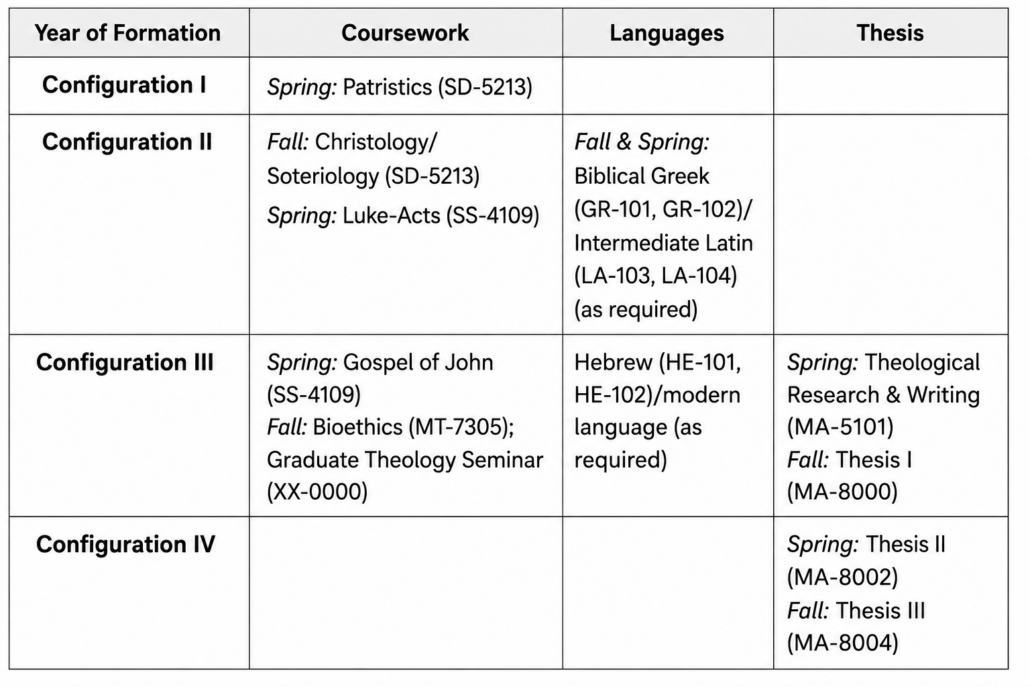
The sequencing of the MA (Theology) coursework and thesis is as follows:
Student Designated Courses (9 credits) – to be done in consultation with the MA Program Director and reported to the Registrar Courses transferable from the MDiv program should include a minimum of 3 credits from each Department (Sacred Scripture, Dogmatic Theology, and Moral Theology). The student must achieve at least a B in these courses for successful completion of the requirement.
Transfer Credits
- For those students earning MA and MDiv degrees concurrently, up to 9 credits may be transferred from the MDiv program to the MA program (excluding Pastoral Studies courses).
- MA students can transfer up to 12 credits of graduate-level theology courses from an accredited outside institution.
- For students enrolled concurrently in the MA and the MDiv programs, credits transferred to the MA program from an outside institution count among the total of 9 transferable credits.
- For students enrolled concurrently in the MA and the MDiv programs, MA students may transfer 2 credits from the Graduate Theology Seminar to the MDiv., and thereby satisfy the requirements of one of the two required Theology Electives.
The MA Thesis
A thesis is a scholarly work that reflects the study, research, and writing skills that characterize higher education. The thesis must demonstrate the student’s ability to do research, to analyze primary texts, and to consult, utilize, and evaluate scholarly literature on those texts. Students are required to complete a thesis with a minimum of 60 pages but not to exceed 80 pages in length (not including title page, table of contents, nor bibliography) under the direction of a faculty member, as well as orally defend the thesis before a board of two: the thesis director and one reader.
Topics must be approved by the thesis director, Director of the MA Program, and a majority of the MA (Theology) faculty present at the relevant admissions meeting prior to the student beginning his thesis. The student is advised to obtain thesis guidelines and to discuss thesis plans with the MA Program Director and his thesis director early in his program of study.
Additional Requirements
- A minimum grade cumulative point average (GPA) of 3.5 is required.
- The thesis must be submitted within five years of the completion of all coursework unless a waiver is granted by the Director of the MA Program.
- The thesis board evaluates the writing and oral defense of the MA thesis in accordance with the established MA (Theology) thesis rubric (where the requirements for a pass and a distinction are also set out). The board consists of the thesis director and one reader who will be appointed by the Director of the MA Program.
- The student must demonstrate reading proficiency in one ancient or one modern language that is relevant to their thesis research according to the relevant item in the thesis rubric.
- Students must participate in assessment of the academic program, including completion of a Graduating Student Questionnaire during their final year of coursework.
Costs
There is a per credit hour continuance fee in the MA program for all seminarians who do not successfully defend their theses by the end of their Fourth Year of Theology. This continuance fee also applies to non-resident MA students after completion of all coursework requirements. For more information, contact the Director of MA (Theology) Program.